
Rural Wi-Fi and Point-to-Point Wireless Links for Farms and Outbuildings
Published October 29, 2026 by the FineLine Low Voltage Solutions team
On a rural property, the internet usually arrives at the house. The shop, the pole barn, the guest cabin and the gate are another story. Wi-Fi from the house rarely reaches them, and the usual fixes, like plug-in extenders and mesh units set in a window, tend to be slow and drop out. Our team solves this by bringing a real network connection to each building first, then adding Wi-Fi inside it.
Why Wi-Fi does not reach the barn
Wi-Fi is a short-range radio signal. It weakens quickly with distance and loses much of its strength passing through walls, trees and metal. Pole barns and steel shops are especially hard, because metal siding and roofing block most of the signal from outside. An extender placed between the buildings only repeats a signal that is already weak, so speeds drop and connections come and go.
The reliable fix is to give each building its own wired or wireless backbone connection, and then put an access point inside or on it.
Option 1: buried Ethernet
Where a trench is practical, buried Ethernet in conduit is the most dependable link. A single Ethernet run is limited to about 328 feet (100 meters), so we plan each run to stay within that distance. When a building is farther out than one run can reach, or trenching is not practical, a point-to-point wireless link is usually the better fit.
Buried Ethernet is a good fit when the building is fairly close, the ground is easy to trench, or you are already digging for power or water.
Option 2: a point-to-point wireless link
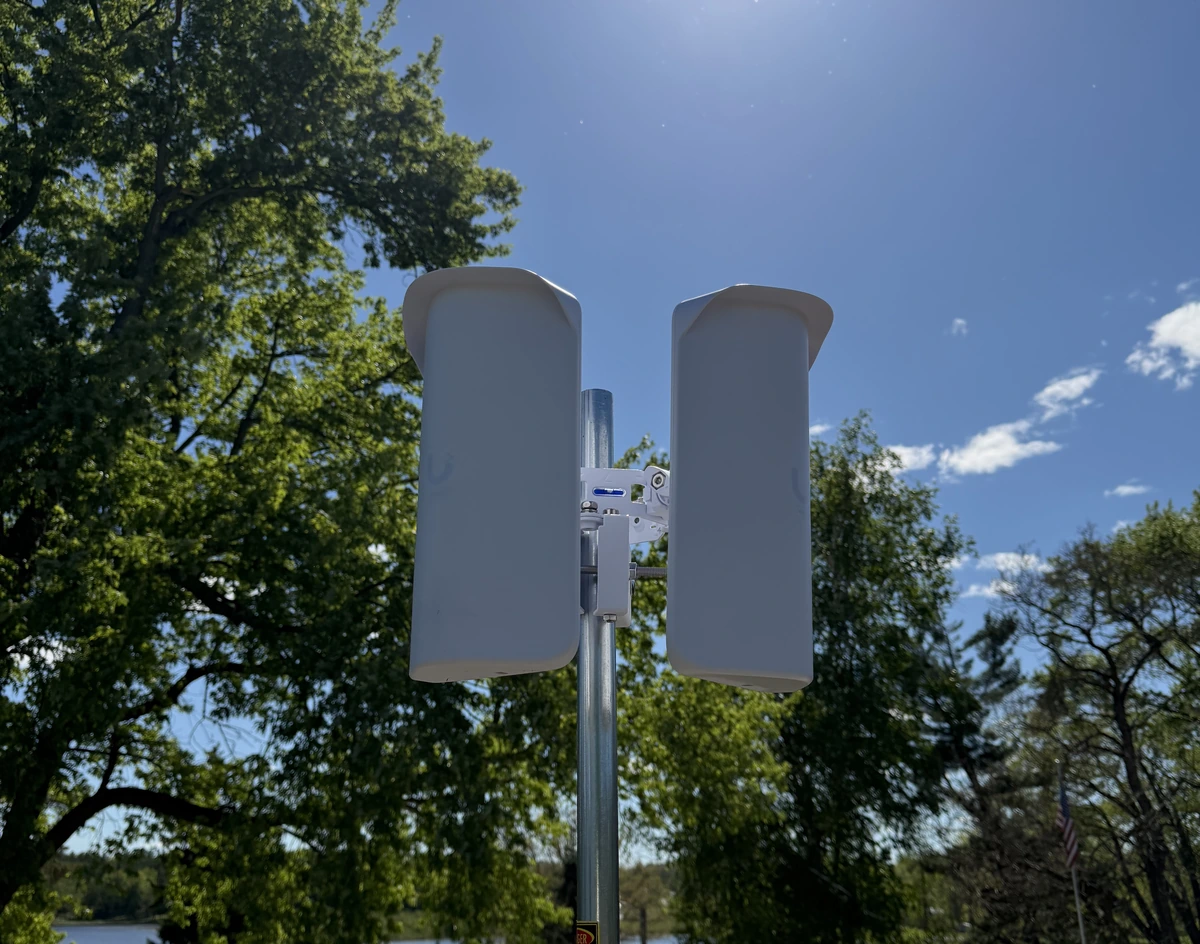
A point-to-point link uses two outdoor radios, one at each building, aimed directly at each other. Because the signal is focused in a narrow beam instead of spread in every direction, these links can carry a fast, stable connection over long distances, often far beyond what any Wi-Fi router can reach. No trench is needed.
When several buildings need a connection, we can build a point-to-multipoint network: one access radio at a central point sends the signal out, and a small receiver on each building picks it up.
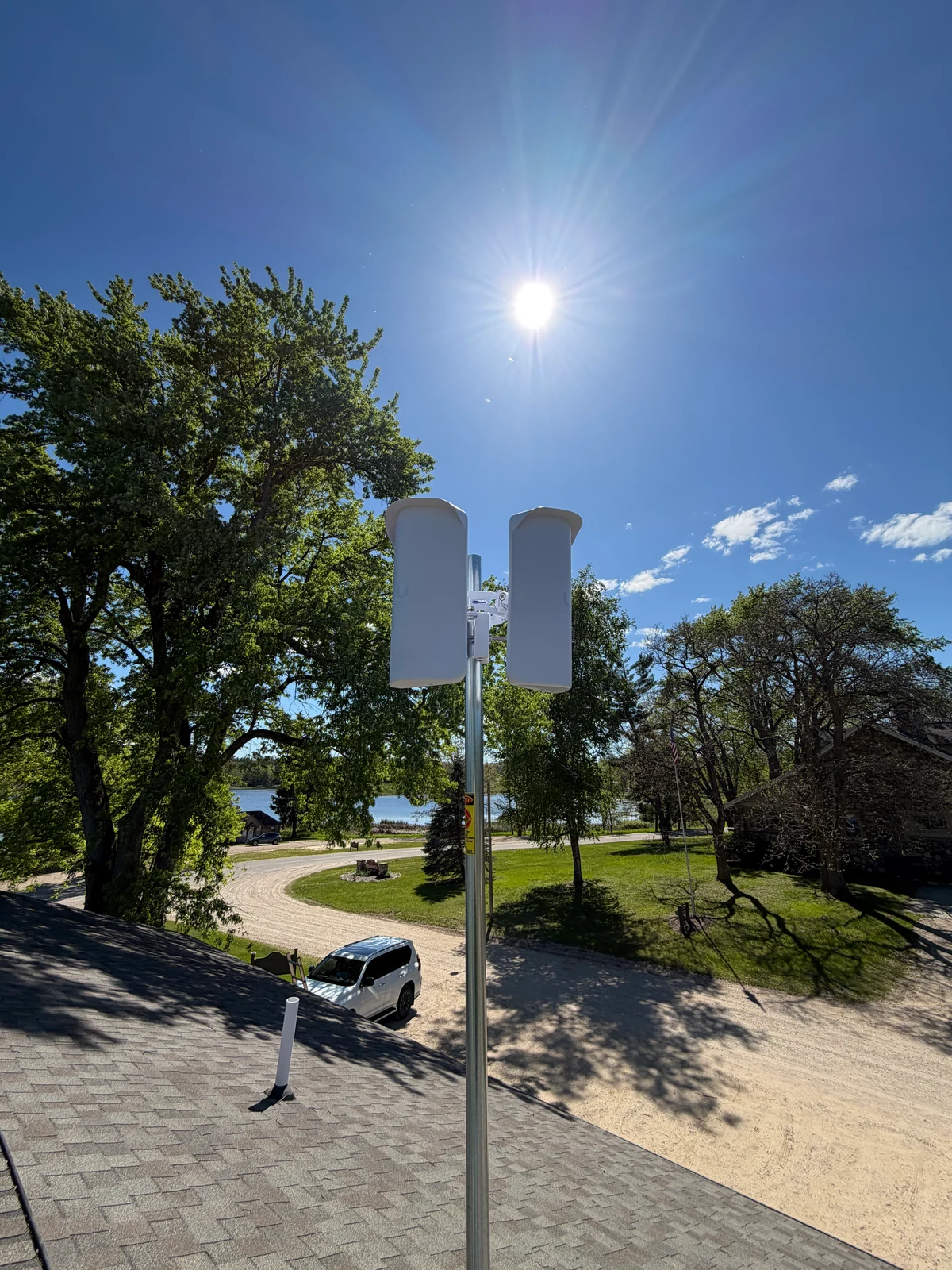
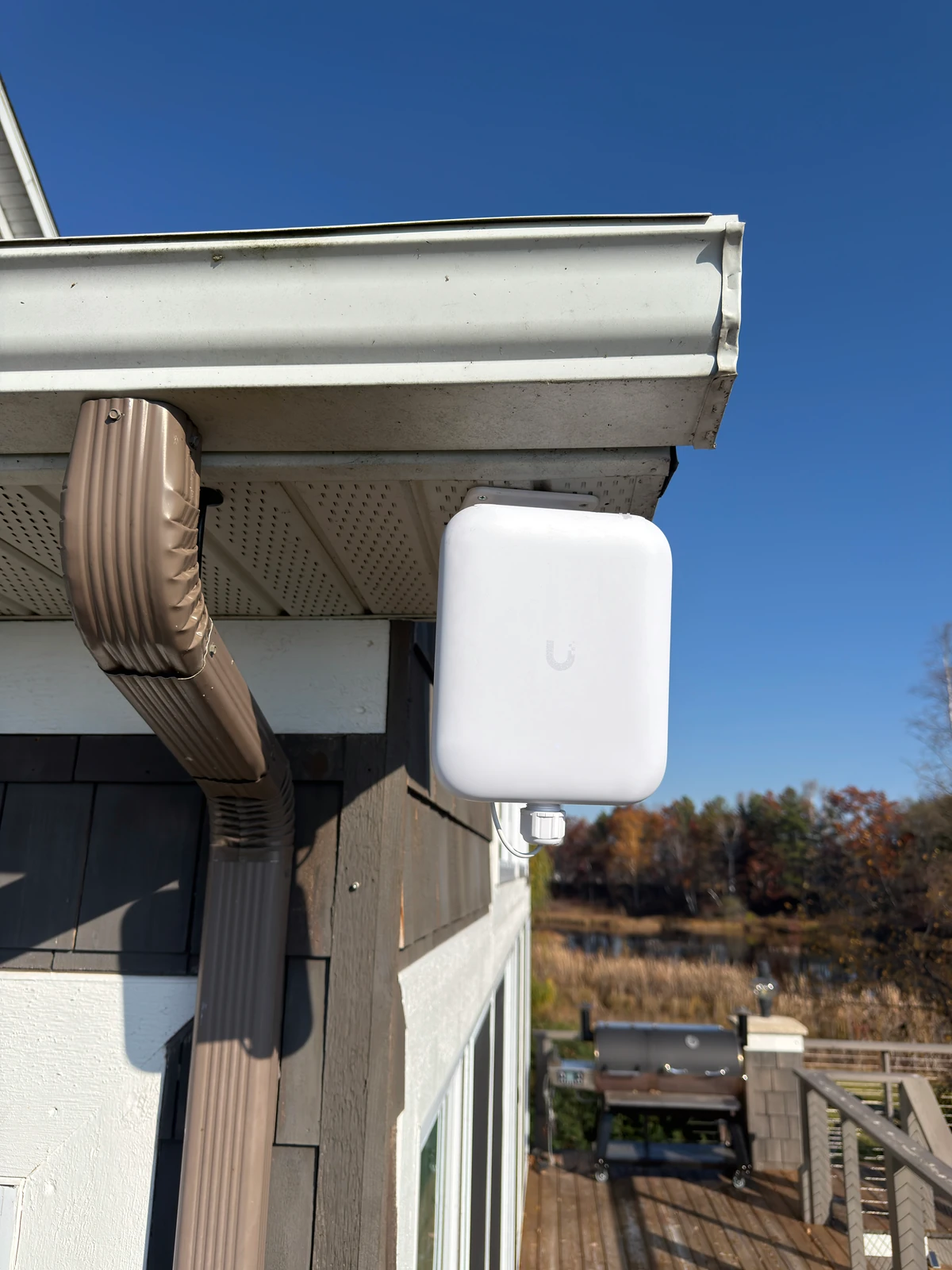
That is what we built on a large ranch property: UISP Wave AP Gen2 access points on a central mast send the signal out, and a UISP Wave Nano receiver on each building connects it to the network. We aimed and tested every link, added Ethernet surge protection on the outdoor runs, and set up a UISP Console so the whole system can be monitored from one place.
Line of sight matters
Wireless links need a clear path between the two radios. Trees, hills, silos and buildings in the way weaken or block the signal, and leaves can make a link that works in winter weaker in summer. Before quoting, we look at the path between buildings and choose mounting points, such as a roof mast, a gable or a pole, that clear the obstacles. If there is no clear path, we may route the link through a middle building or recommend cable instead.
Wi-Fi inside the building
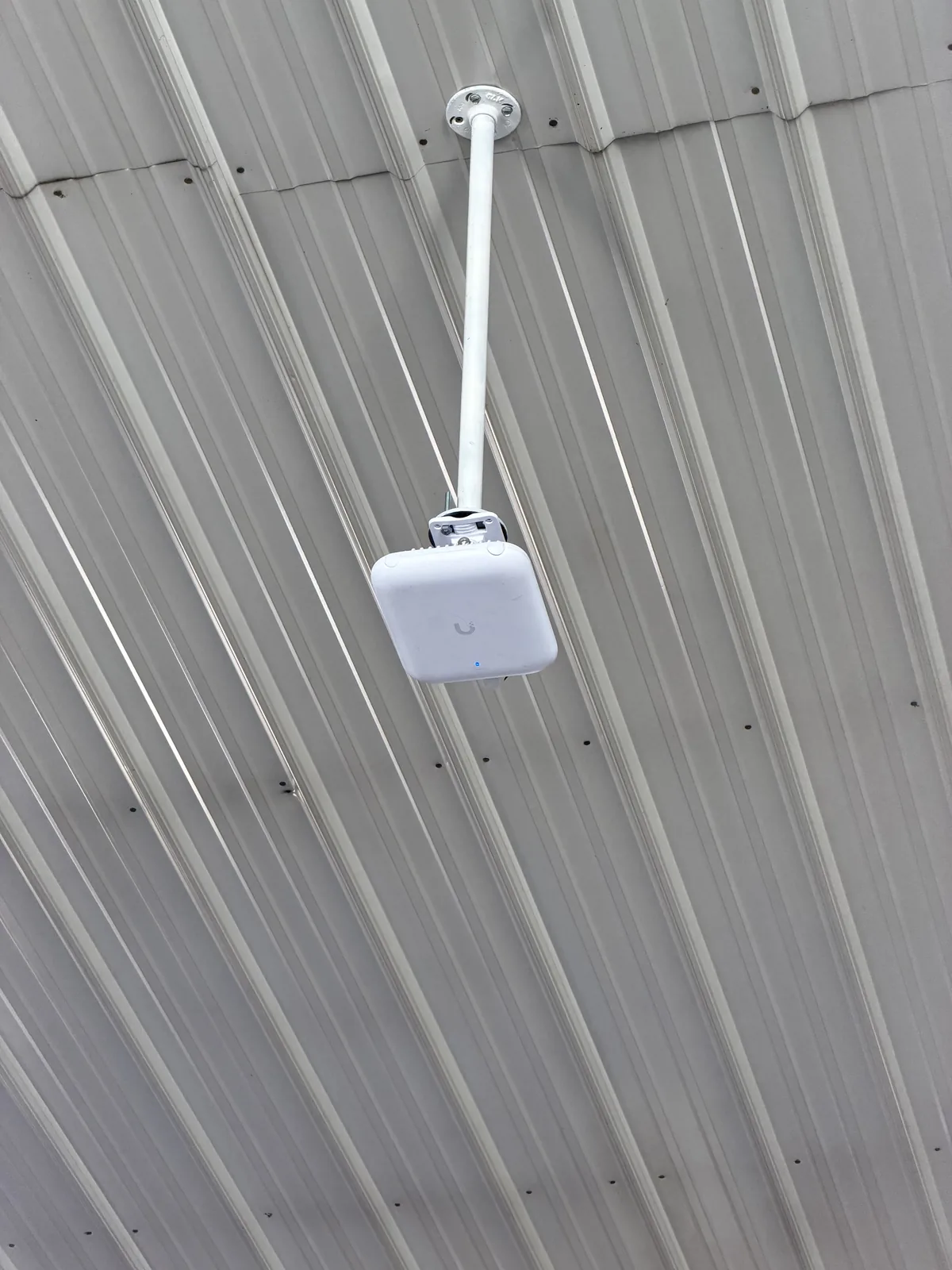
Once the connection reaches the building, we install an access point where it will cover the space. In a metal pole barn that usually means inside, mounted from the ceiling. In our pole barn shop Wi-Fi project, a UniFi U7 Pro Outdoor access point hangs on a drop mount for even coverage across the floor, fed by one outdoor-rated Cat6A cable that carries both data and power. For yards, decks and docks, outdoor access points mounted under an eave cover the space around the building.
Because every building is part of one network, your phone moves between the house, the shop and the yard without switching networks, and you can manage the whole system from one app.
More than Wi-Fi
Once a building is connected, it can carry more than internet. Security cameras on the barn, a keypad or intercom at the gate, and VoIP phones in a farm office can all run on the same network. See our security camera guide and gate access guide for those projects.
Planning your project
Helpful details for a quote: how far each building is from the house, what is between them, whether the buildings have power, and what you want to do in each one. We connect outbuildings as part of our Wi-Fi installation work for farms and rural homes around Big Rapids, Canadian Lakes, Mount Pleasant, Cadillac, Rockford, Cedar Springs and surrounding areas. Estimates are free.
Frequently asked questions
How far can a point-to-point link reach?
With clear line of sight, much farther than any Wi-Fi router. The actual range depends on the radios and the path, which we check on site.
Is a wireless link as reliable as cable?
A well-aimed link with a clear path is very reliable. Cable is still the first choice where trenching is practical.
Will Wi-Fi work inside my metal pole barn?
Yes, with an access point inside the building connected by cable or a wireless link.